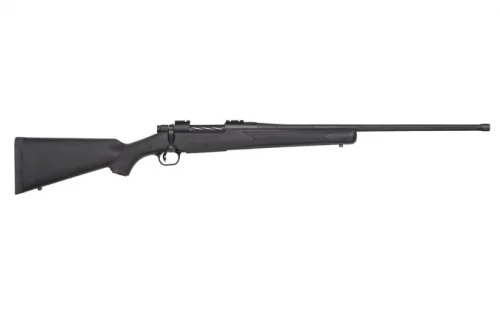
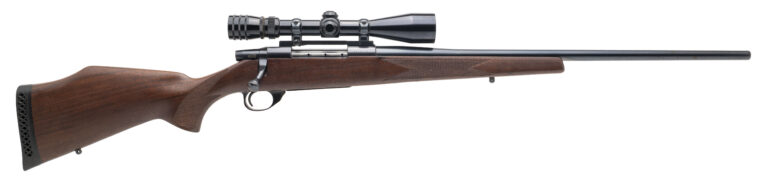
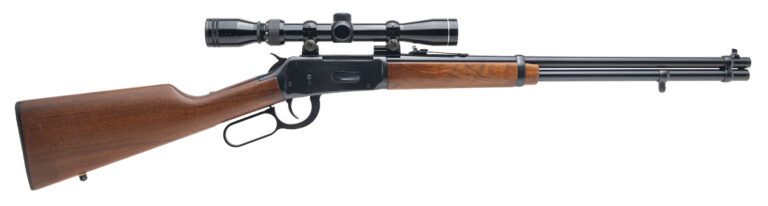
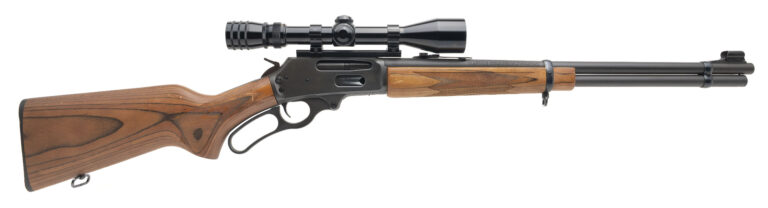
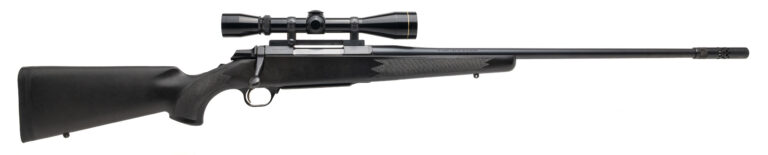
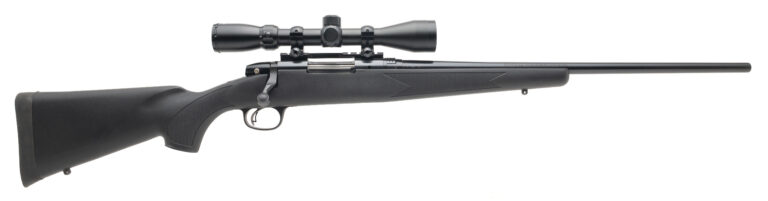
Big-Bore Rifles: From the .45-70 and .450 Bushmaster to the .338 and .375
A big-bore rifle throws a heavy bullet. Some do it slowly, like the .45-70 in a lever gun that has been killing deer and bear since 1873; some do it fast, like a .338 Winchester Magnum built for elk at four hundred yards. They solve different problems, and a growing number of states have created a third problem by limiting deer rifles to straight-walled cartridges, which has made the big straight-walls the most popular new rifle cartridges of the decade. This guide covers the families, the rifles and the rules.
The straight-walls
Ohio, Iowa, Indiana and southern Michigan allow deer rifles only in straight-walled cartridges, a rule written to keep rifle ranges short in flat, populated farm country. The .450 Bushmaster was the first cartridge built for that market, firing a two-hundred-and-fifty-grain bullet at about twenty-two hundred feet per second from both bolt rifles and AR-platform rifles; it is a two-hundred-yard deer and hog cartridge that hits like a hammer and recoils like a .30-06. The .350 Legend followed as the light-recoiling alternative, a hundred-and-fifty-grain bullet at about twenty-three hundred feet per second with recoil close to a .243 and the same platforms. The .45-70 also qualifies in every straight-wall state. If you hunt in one of those states, one of these is your deer rifle whatever else is in the safe.
The .45-70 Government
The .45-70 is the oldest cartridge still in common use and one of the most versatile. Factory loads span from mild cowboy-action ammunition to modern high-pressure loads meant only for strong lever guns and single-shots, and the difference between them is the difference between a deer rifle and a brown-bear rifle. In a Marlin 1895, a Henry or a Ruger-made Marlin, with a three-hundred-grain bullet, it is a hundred-and-fifty-yard rifle for anything in North America inside that range. Recoil with heavy loads is serious; a good recoil pad and a rifle of seven pounds or more help. It is legal everywhere and beloved in the timber.
Lever guns in pistol calibres
A lever carbine in .44 Magnum or .357 Magnum pairs with a revolver in the same calibre and turns the revolver's cartridge into a hundred-and-fifty-yard deer and hog gun with almost no recoil. Marlin's 1894, Henry's Big Boy and Rossi's R92 are the common ones. The .44 carbine is the quietest big-bore combination for a first-time hunter and a fine truck gun in hog country.
The .30-calibre magnums
The .300 Winchester Magnum is the most common elk cartridge in the mountain states for a reason: a hundred-and-eighty-grain bullet at nearly three thousand feet per second reaches four hundred yards with energy to spare and shoots flat enough to make the shot. The .300 PRC and the .300 Weatherby do the same with different cases. Recoil is significant, a bit more than a .30-06, and a rifle of eight pounds with a good pad or a brake is what makes it shootable. For elk and mule deer in open country it is the standard.
The .338 and .375
The .338 Winchester Magnum fires two-hundred-and-twenty-five and two-hundred-and-fifty-grain bullets and is the classic large-bear and elk cartridge of Alaska and the northern Rockies, with recoil that demands practice. The .375 H&H and the .375 Ruger are the world's all-round dangerous-game cartridges and are more than any North American animal needs, though guides in brown-bear country carry them. Both are specialist rifles; buy one for a specific hunt, not as an all-rounder.
Optics on a big-bore rifle
A .45-70 or a .450 Bushmaster wants a low-power scope, a one-to-four or a two-to-seven, or a red dot, because the shots are short and fast and the field of view matters more than magnification; a fixed four-power in a solid mount is the traditional and correct choice. A .300 or .338 magnum for open country wants a three-to-nine or a four-to-twelve with a sturdy tube and rings torqued to specification, because magnum recoil finds every loose screw and cheap scopes lose zero under it. Whatever the glass, check the zero after the first fifty rounds on a heavy-recoiling rifle; rings settle.
Ammunition and the two-load rifle
A big-bore rifle is really two rifles depending on the load. The .45-70 with cowboy loads is a mild, pleasant deer rifle; with modern heavy loads it is a bear rifle that kicks accordingly. The .450 Bushmaster and .350 Legend have a narrower spread but still shoot best with one bullet weight the rifle prefers. Buy two boxes of each candidate, shoot groups from a rest, keep the winner and buy a case of it; changing loads mid-season changes the zero.
Recoil and rifle weight
Every cartridge on this page kicks. Recoil energy rises with bullet weight and velocity and falls with rifle weight, so a nine-pound .338 is more pleasant than a six-pound .45-70 with heavy loads. A muzzle brake cuts recoil by a third at the cost of blast that requires ear protection even for a single shot in the field; a good recoil pad and a properly fitted stock cut it enough for most people. A shooter who flinches misses, and a missed elk at three hundred yards is worse than a clean kill with a .30-06.
Choosing
- Straight-wall state, deer and hogs: .350 Legend for most hunters, .450 Bushmaster for big deer and heavy cover.
- Timber and short shots anywhere: .45-70 lever gun or a .44 Magnum carbine.
- Elk and mule deer in open country: .300 Winchester Magnum in an eight-pound rifle.
- Large bears and moose: .338 Winchester Magnum or .375.
- One rifle for everything east of the plains: a .45-70 with two loads, mild and heavy.
The rules guide lists the straight-wall states and the season rules, and the revolver guide covers the handgun half of a matched pair. Browse .45-70 rifles, .450 Bushmasters and lever guns in the catalogue, and see your state's deer-rifle rule on the city pages.
General information, not legal advice. Current as of September 2026. Laws change; check the official source before you act.